
Slideshow Pilgrimage
A disappointing visit

Many years ago I went to the National Archives for the first time as an adult. I had been there before, and remembered it as an awe-inspiring temple of the human aspiration to freedom. After you had gazed upon the sacred documents of the American Founding, there was a two-story high wall, behind which hung the actual Star Spangled Banner. The one that hung over Fort McHenry in 1812. In order to protect the banner from light, it was hidden behind the moveable wall. At specific times you could be standing nearby, and there would be a flurry among the crowd, as everyone clustered around. I remember my big sister pushing me toward the front so I could see. The wall would be raised—or lowered, I don’t recall which—and the banner would be revealed. It was, for my youthful self, a deeply moving experience.
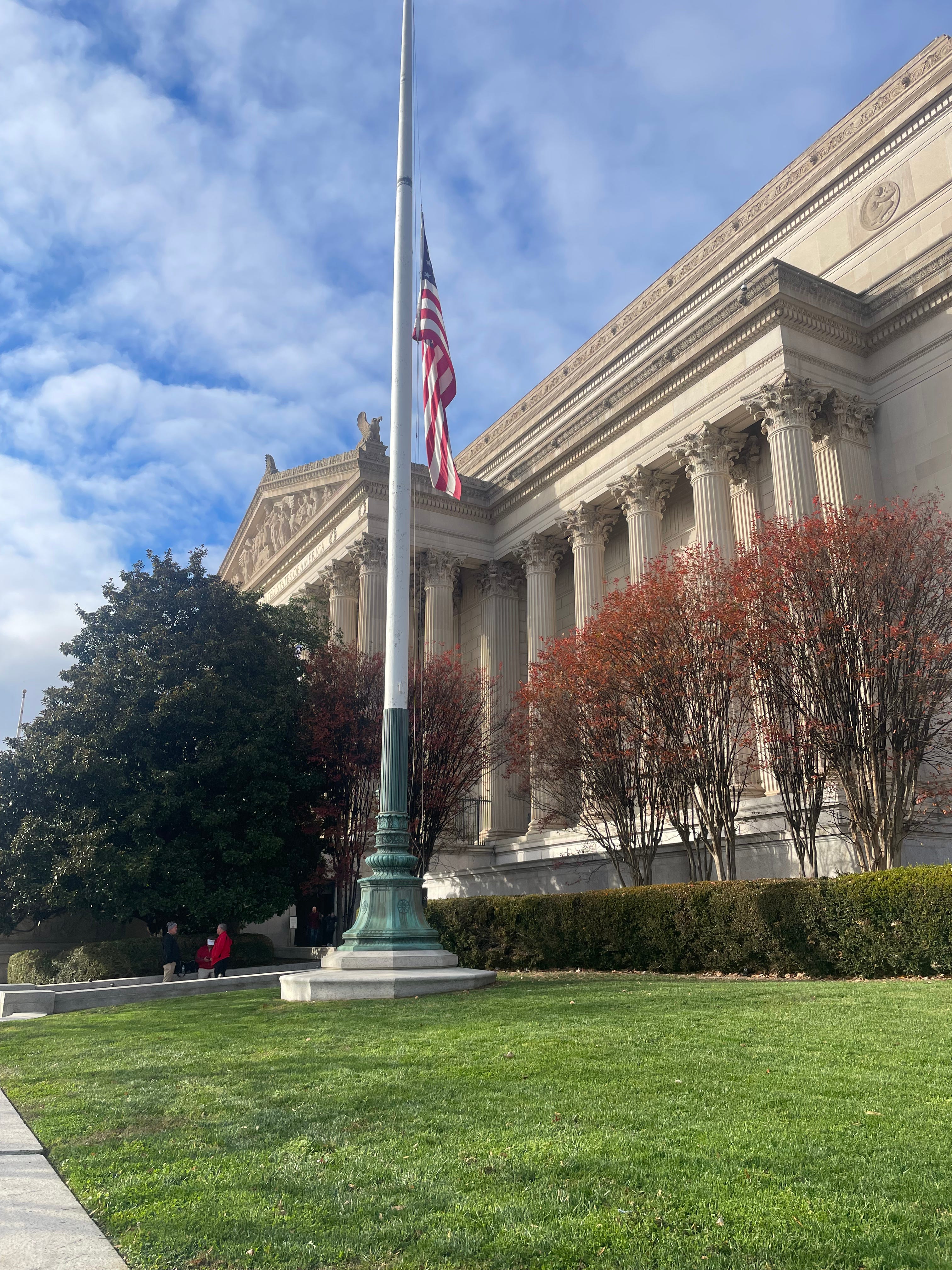
For my adult self, on my last visit, despite my own reverence for the experience of seeing the Declaration of Independence, The Constitution, and The Bill of Rights, I was so appalled at the ignorance of the young people there, who clearly had no idea what they were looking at that I went home and wrote about it. I don’t know where that essay is now, but the gist of it was that if young people didn’t understand American History or Civics, we had no hope of preserving our freedoms.
Well.
I recently read British literary critic Henry Oliver’s account of his visit to the National Archives. Thus inspired, I suggested to my husband that our upcoming visit to DC would be a good time to go back. So after a calming sojourn at the National Gallery and a lunch with what I suspect were forty day old potato chips (the government shutdown having just ended), we strolled over to the archives. Cheerfully, we mounted the majestic stairs, only to discover that the doors there were closed and locked. We had approached from the side and not seen the signs directing us to a side door.
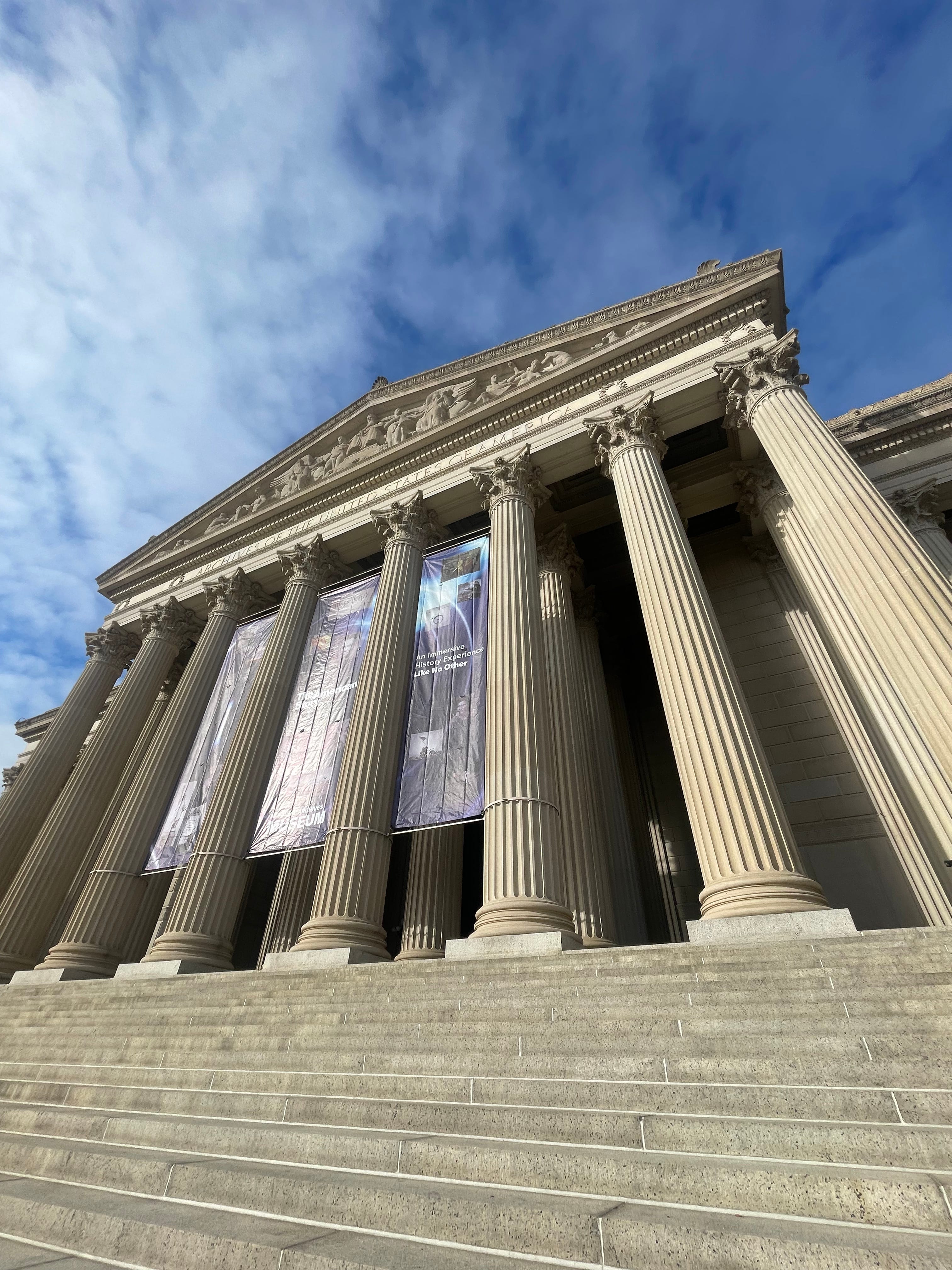
That one signal should have warned me of what was to come. After we had entered by going down some basement stairs and winding our way through a dark back hallway, we emerged into a space with ugly florescent lighting, metal detectors, and grumpy security people. Honestly, I can’t say I blame them for being grumpy. For all I know they hadn’t gotten their backpay yet, and anyone dealing with the public in general and hoards of teenagers in particular is likely to be living on their last nerves. But still. What had once felt like a temple of the holies now felt more like the DMV in a decrepit part of town.
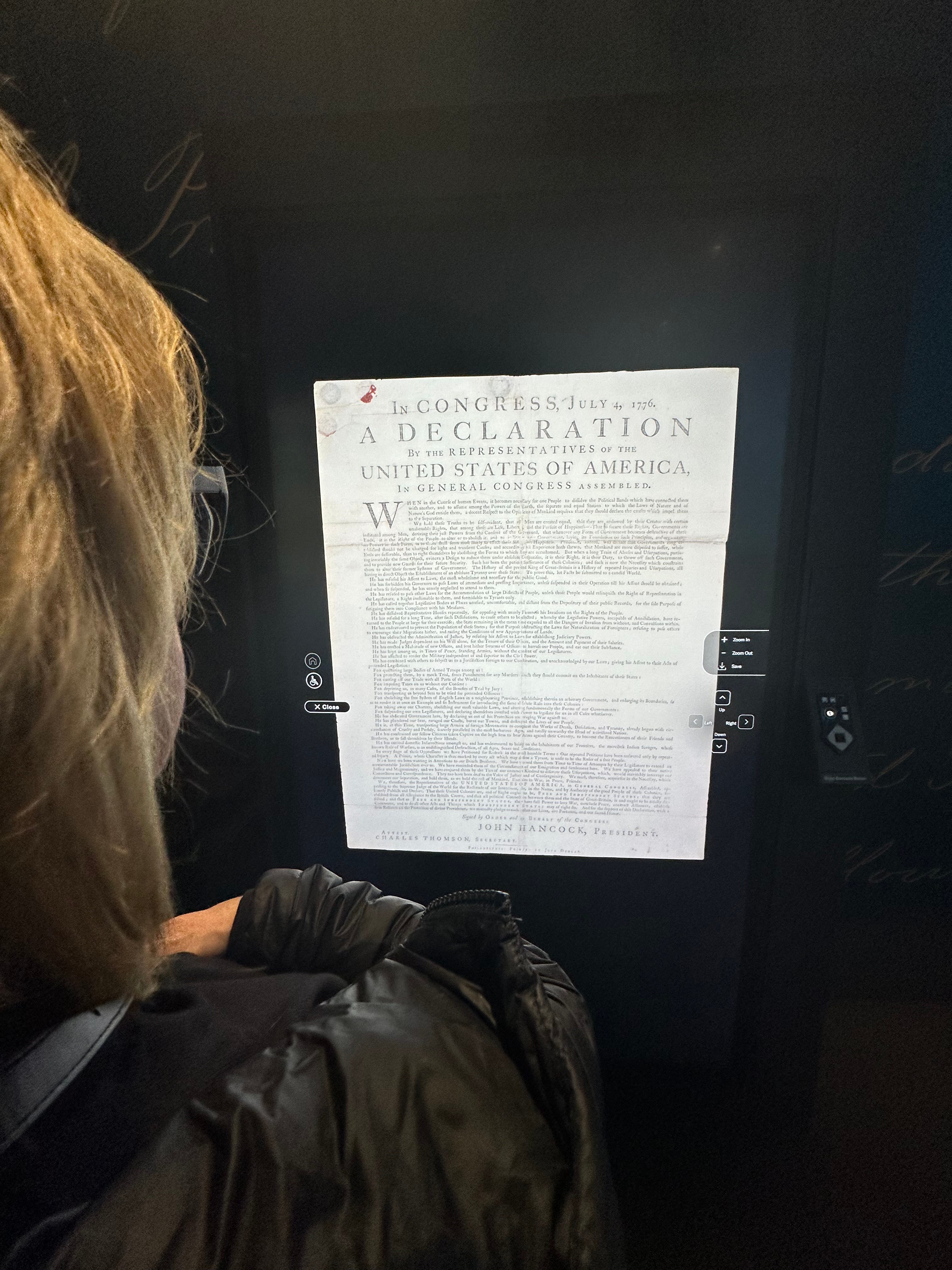
This, I should hasten to say, is not for lack of money spent. There were a number of new exhibits beckoning, but we decided to start with the main thing: the documents. The big ones are still there to witness first hand: The Declaration of Independence; The Constitution; The Bill of Rights. They are faded, and barely legible. But I remember standing in the hall last time, waiting my turn to gaze upon the Declaration. While we waited we had been permitted to read other authentic treasures, like the letter appointing Benjamin Franklin Postmaster General of the colonies in 1775, another letter from Abraham Lincoln, and various other somewhat random, but nevertheless fascinating documents of our national history. Now, however, those accompanying documents—although they look authentic—are all marked with the label “Facsimile”. I understand that the originals need to be protected, but I would have thought that this kind of careful conservation and protection was the whole point of an archive. I can see a facsimile in my own living room. The amazing part should be gazing upon the paper once held by Lincoln, or Franklin, or Grant, and feeling the reality of them. That’s why we go to museums, isn’t it? To really see and know that these things exist; that they happened; that they aren’t dead stories.
The hall was filled with teenagers wearing hoodies announcing they were part of a traveling classroom for American history. Normally, I would assume that a program of this kind would include actually learning the history, but apparently not. The comments of the students were, if anything, more disheartening than the last time I was there. They had not the faintest idea of what they were looking at, or why it mattered, and so far as I could see, the chaperones were not engaged in helping them to understand. Perhaps, like the guards, they were worn to a nub. Or perhaps they didn’t know either.
From there we went to the big interactive exhibit designed to explain to Generation Iphone what the archives held and why it mattered. This, although it had the trappings of bar codes and personalization, was nothing more than a glorified interactive slide show. The searches I tried did not seem responsive in any way to what I asked to see—it was just a series of preset options, like a menu at Taco Bell. And the slide shows—although immersive and accompanied by music and actors’ voices reading quotes—struck me as superficial, and didn’t seem terribly effective at holding the attention of the younger visitors, either. You can bet, however, that donors were wooed out of millions to create it. Frankly, I’d rather they’d spent the money on protecting real documents so we could look at them. Or maybe playing the musical 1776 on a loop. At least there’d be singing and dancing. They could do it in IMAX.
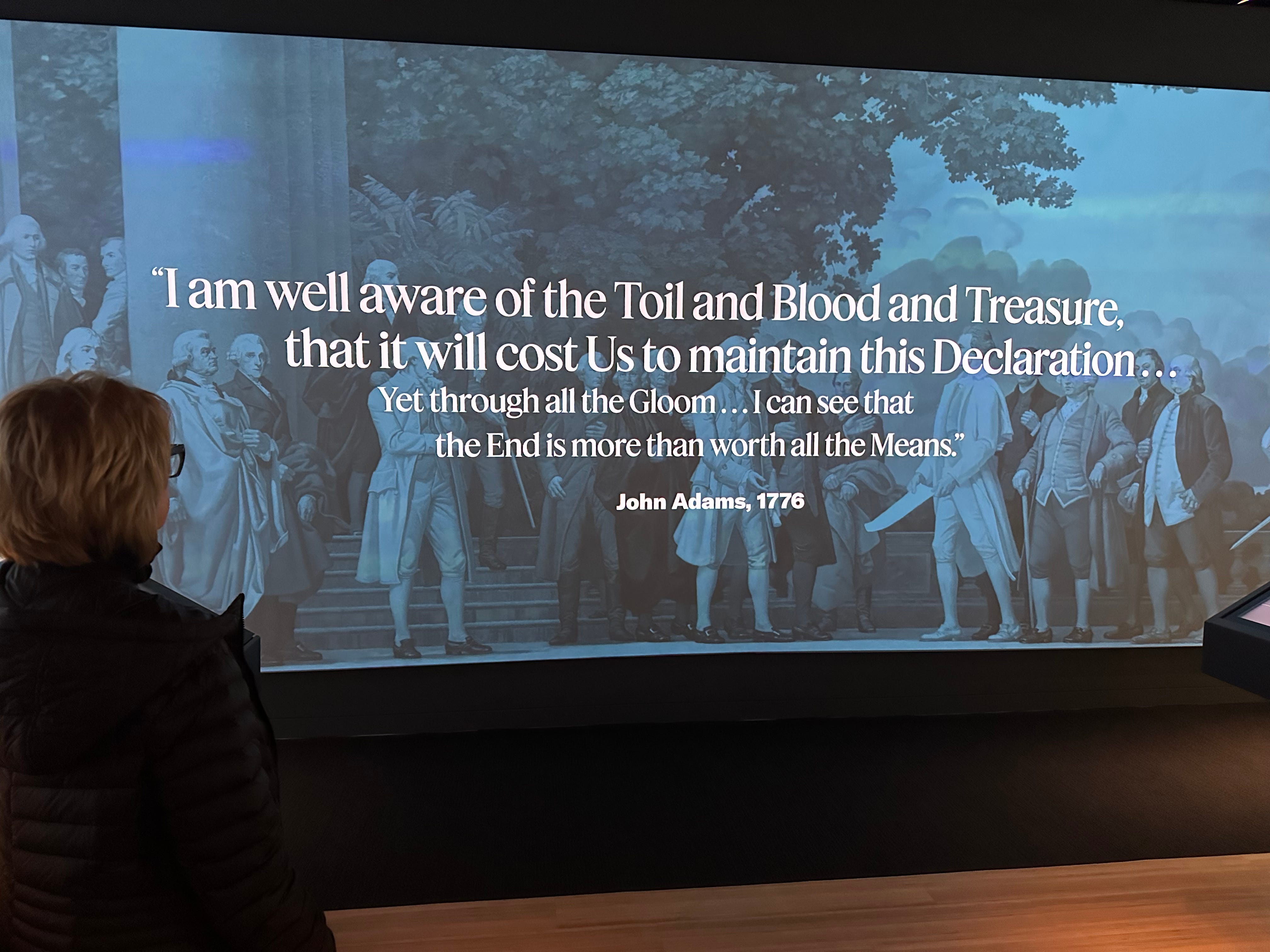
Full disclosure requires me to report that my husband thought it was splendid and that I was being a crank, and maybe he’s right. But what I had expected to be an exhalted experience, a refreshment of the spirit, left me feeling drained and depressed. This is not the desired reaction to the artifacts of our history. A pilgrimage to a holy place is supposed to leave you transformed by the experience. If there were a campaign to renovate the archives back into that kind of place, I would be the first to contribute.
As a nation, I think we could use it.
***
“All shall be well, and all shall be well, and all manner of thing shall be well.” ~Julian of Norwich
I am immensely grateful for my paid subscribers. I know times are hard, and your willingness to invest in my work is deeply inspiring to me and very much appreciated. It is a trust I take seriously. Lately it feels as if the world is losing its collective mind, and it’s difficult to look out and see the chaos around us. But we are not the only human beings in history who have lived through trying times, and although we are required to do what is right, adversity does not require us to live in abject misery. It’s essential to remind ourselves of the good things in the world, so I hope these posts provide a place of refuge for my readers. So, come and hang out with me, the dogs, and this stalwart little community of good people. We need one another. And remember: We do not have to live on bended knee.
Also: dog photos.
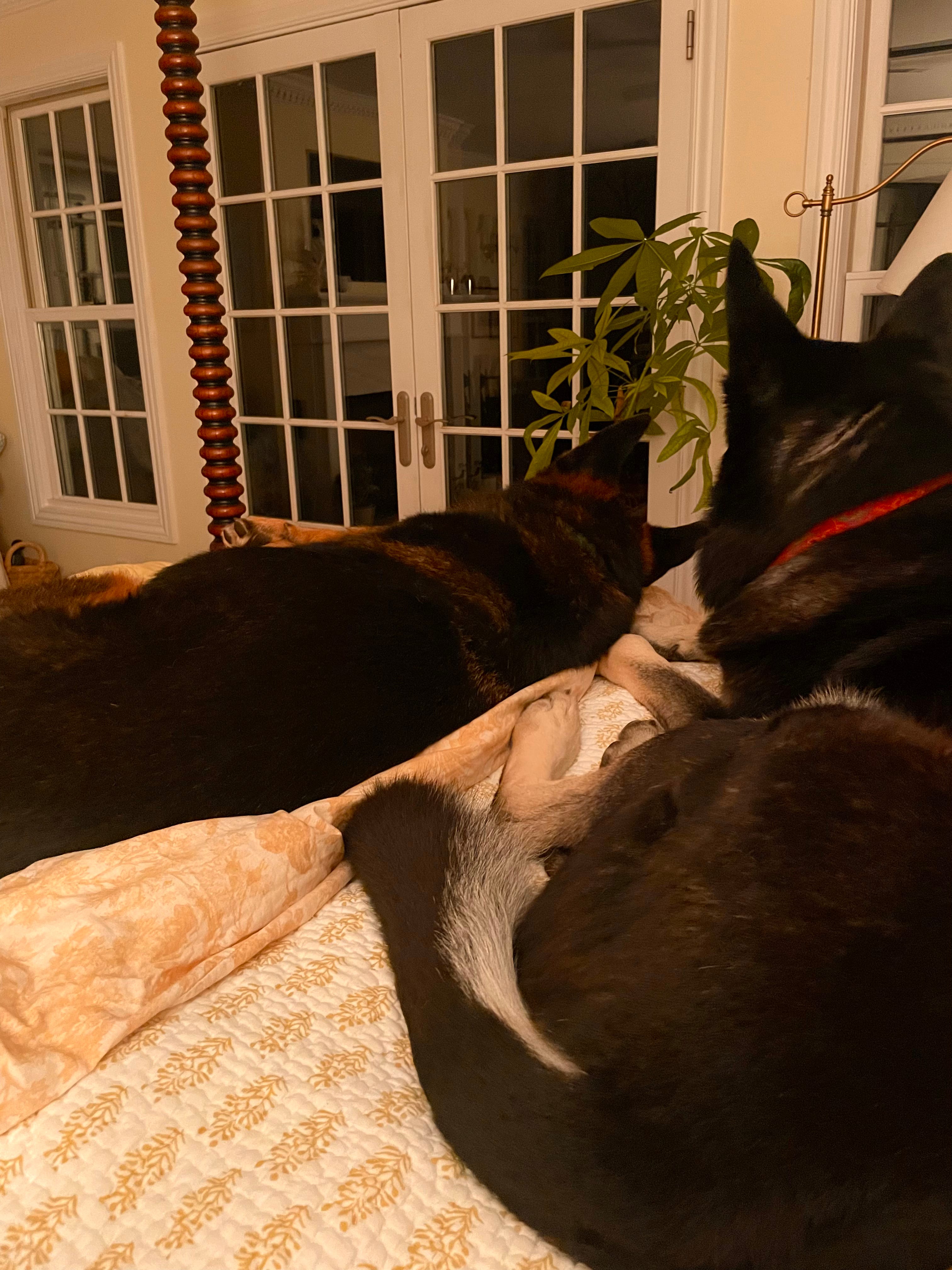
And now for your gratuitous dog photo:
Thanks so much for your insight, which, as here, can be painful as well as inspiring. The movable wall should reveal the sacred. Maybe one of the treasures now absent is one that we should be bringing into the archives but can't because it may be missing in ourselves: our ability to feel that things matter, that they mean something beyond our own lives, that they inspire us to be part of.
Screens, screens, screens. I'm not a technical luddite in the slightest, but there's very little curation anywhere about when screens & other Hollywood whizzbangs like sound effects and lighting are appropriate and when they are not.
The place for facsimiles is online, in my opinion. For example, the Bodleian Library has an astonishing array of ancient manuscripts that can be examined extremely closely at high resolution, by anyone, for free. FOR FREE!